
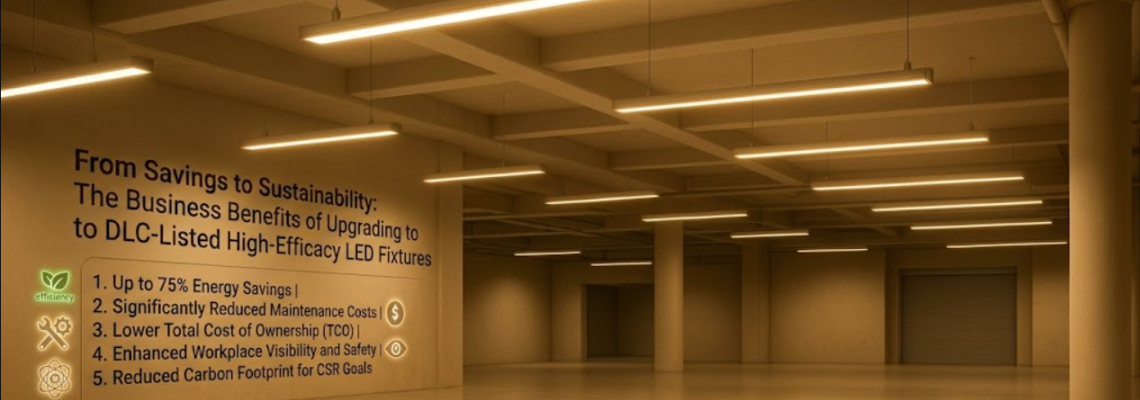
In today’s competitive business environment, organizations are under constant pressure to reduce operating expenses while meeting ambitious sustainability goals. Rising electricity costs, stricter energy regulations, and growing environmental awareness have encouraged businesses to invest in technologies that deliver long-term financial and environmental benefits. One of the most effective upgrades is the transition to DLC-listed high-efficacy LED fixtures, which offer superior energy efficiency, exceptional lighting performance, and reliable long-term value.
Lighting is one of the largest contributors to energy consumption in commercial and industrial buildings. Traditional lighting technologies, such as fluorescent, metal halide, and high-pressure sodium fixtures, consume more electricity, require frequent maintenance, and have shorter lifespans. In contrast, DLC-listed high-efficacy LED fixtures provide brighter, more uniform illumination while using significantly less energy. Certified by the DesignLights Consortium (DLC), these fixtures meet strict standards for efficiency, durability, and performance, making them a trusted solution for modern facilities.
Beyond lowering energy bills, DLC-listed LED fixtures help businesses qualify for utility rebates, reduce maintenance costs, improve workplace safety, and support environmental initiatives. Whether upgrading an office, warehouse, retail store, manufacturing facility, healthcare center, or educational institution, these advanced lighting solutions provide measurable returns that extend well beyond simple cost savings. This article explores how upgrading to DLC-listed high-efficacy LED fixtures helps businesses achieve greater profitability while advancing their sustainability objectives.
What Are DLC-Listed High-Efficacy LED Fixtures?
High-efficacy LED fixtures are designed to maximize light output while minimizing electricity consumption. Their efficiency is measured in lumens per watt (lm/W), with higher efficacy indicating greater performance and lower energy usage.
A DLC-listed fixture has been independently tested and approved by the DesignLights Consortium (DLC), ensuring it meets rigorous requirements for:
Energy efficiency
Light output
Product reliability
Thermal performance
Long operating life
Overall quality
Products listed on the DLC Qualified Products List (QPL) provide businesses with confidence that their lighting investment will deliver verified performance and long-term savings.
Why Businesses Are Choosing DLC-Listed LED Lighting
As organizations strive to improve operational efficiency, lighting upgrades have become a priority because they offer one of the fastest returns on investment.
Businesses choose DLC-listed LED fixtures because they provide:
Significant energy savings
Lower maintenance costs
Eligibility for utility rebates
Improved lighting quality
Reduced environmental impact
Compliance with evolving energy standards
Compatibility with smart building systems
These benefits make DLC-listed LEDs an essential component of modern, energy-efficient facilities.
1. Lower Energy Costs
One of the most immediate benefits of upgrading to DLC-listed high-efficacy LED fixtures is a substantial reduction in electricity consumption.
Compared to traditional lighting technologies, LEDs use significantly less power while maintaining or improving illumination levels.
Businesses can experience:
Lower monthly electricity bills
Reduced peak energy demand
Improved facility efficiency
Long-term operational savings
For facilities operating lighting around the clock, these savings can translate into thousands of dollars annually.
2. Access to Utility Rebates
Many utility providers encourage energy-efficient upgrades by offering financial incentive programs.
DLC-listed fixtures often qualify because they meet independently verified performance standards.
Rebate programs help businesses:
Lower upfront investment
Offset installation costs
Accelerate ROI
Improve project affordability
Taking advantage of these incentives makes LED retrofits more financially attractive.
3. Reduced Maintenance Expenses
Maintenance represents a significant cost in large commercial and industrial facilities.
DLC-listed LED fixtures commonly last between 50,000 and 100,000 hours, dramatically reducing maintenance requirements.
Longer lifespan means:
Fewer replacements
Reduced labor costs
Less equipment downtime
Lower inventory requirements for replacement lamps
Facilities with high ceilings particularly benefit from reduced maintenance frequency.
4. Improved Lighting Quality
High-quality lighting contributes directly to workplace efficiency and occupant comfort.
Modern DLC-listed fixtures provide:
Uniform illumination
High Color Rendering Index (CRI)
Minimal glare
Instant startup
Flicker-free performance
Consistent brightness
Better lighting improves visibility while creating more comfortable environments for employees and customers.
5. Increased Employee Productivity
Lighting affects concentration, comfort, and overall workplace performance.
Proper illumination helps reduce:
Eye strain
Fatigue
Workplace errors
Visual discomfort
Comfortable employees are more productive, making quality lighting an investment in both people and operational performance.
6. Enhanced Workplace Safety
Reliable lighting is essential in commercial and industrial environments.
Improved visibility reduces:
Workplace accidents
Slip-and-fall incidents
Equipment handling errors
Security risks
Warehouses, factories, parking areas, and loading docks especially benefit from brighter, more consistent LED lighting.
7. Support for Sustainability Goals
Businesses increasingly prioritize environmental responsibility as part of their long-term strategy.
Upgrading to energy-efficient LED lighting helps organizations:
Reduce greenhouse gas emissions
Lower electricity consumption
Minimize waste from lamp replacements
Support ESG initiatives
Contribute toward green building certifications
Sustainable lighting upgrades demonstrate corporate commitment to environmental stewardship while reducing operational costs.
8. Smart Building Integration
Modern facilities rely on intelligent technologies to maximize efficiency.
Many DLC-listed LED fixtures support:
Occupancy sensors
Motion detection
Daylight harvesting
Wireless controls
Dimming systems
Building automation integration
These technologies further reduce energy consumption by ensuring lights operate only when required.
9. Longer Fixture Lifespan
LED fixtures significantly outlast conventional lighting technologies.
Their extended operating life provides:
Greater reliability
Fewer disruptions
Lower replacement frequency
Improved operational continuity
Long-lasting lighting systems reduce total ownership costs while improving facility management.
10. Lower Total Cost of Ownership
Although premium LED fixtures require a higher initial investment, their overall lifecycle costs are considerably lower.
Savings result from:
Reduced electricity bills
Utility rebates
Lower maintenance expenses
Longer operating life
Fewer replacement purchases
Businesses benefit from continuous financial returns throughout the fixture's lifespan.
11. Compliance with Modern Energy Standards
Commercial buildings must meet increasingly strict efficiency requirements.
DLC-listed products help organizations comply with:
Commercial energy codes
Local building regulations
Sustainability programs
Energy-efficiency initiatives
Using certified fixtures also simplifies project documentation and verification.
Industries That Benefit Most
Warehouses
Improve inventory visibility while reducing lighting costs.
Manufacturing Facilities
Support precision work with dependable illumination.
Retail Stores
Enhance product displays while lowering energy expenses.
Office Buildings
Create productive work environments with comfortable lighting.
Healthcare Facilities
Provide reliable illumination for patient care and medical procedures.
Educational Institutions
Improve classroom visibility while reducing operating expenses.
Hospitality
Lower utility costs while improving guest experiences.
Municipal Buildings
Support public sustainability initiatives through efficient lighting.
Best Practices for a Successful Upgrade
To maximize benefits:
Conduct an Energy Audit
Assess current lighting performance and identify opportunities for improvement.
Select DLC-Listed Products
Verify products appear on the DLC Qualified Products List.
Prioritize High-Usage Areas
Upgrade spaces with the longest operating hours first.
Integrate Smart Controls
Use occupancy sensors and daylight harvesting systems to increase savings.
Apply for Rebates Early
Many utility programs require pre-approval before installation.
Monitor Energy Performance
Track energy consumption after installation to measure savings.
Emerging Trends in Commercial LED Lighting
The future of commercial lighting includes:
AI-powered lighting optimization
Internet of Things (IoT)-enabled fixtures
Human-centric lighting
Predictive maintenance
Wireless lighting controls
Advanced building analytics
Adaptive daylight management
High-efficacy DLC-listed LED fixtures are designed to support these innovations, ensuring businesses remain prepared for future technological advancements.
Common Mistakes to Avoid
Avoid these common upgrade errors:
Choosing non-certified LED fixtures
Ignoring rebate requirements
Selecting products based solely on price
Skipping lighting design evaluations
Overlooking smart control opportunities
Failing to calculate lifecycle costs
Proper planning ensures maximum return on investment.
Why DLC Certification Matters
DLC certification provides independent assurance that lighting products meet high standards for efficiency, reliability, and performance.
Businesses benefit from:
Verified product quality
Trusted energy savings
Utility rebate eligibility
Long-term reliability
Reduced investment risk
This certification helps organizations confidently select lighting solutions capable of delivering measurable financial and operational improvements.
Conclusion
Upgrading to DLC-listed high-efficacy LED fixtures is more than a simple lighting improvement it is a strategic investment that helps businesses achieve both financial savings and long-term sustainability. By reducing energy consumption, lowering maintenance costs, improving lighting quality, and qualifying for valuable utility rebates, these advanced lighting solutions deliver measurable benefits that strengthen operational performance and reduce overall ownership costs.
In addition to financial advantages, DLC-listed LED fixtures support workplace safety, employee productivity, environmental responsibility, and compliance with evolving energy regulations. Their compatibility with smart lighting controls and building automation systems also prepares facilities for the future of intelligent energy management.
Whether your organization operates a warehouse, office, retail store, healthcare facility, manufacturing plant, or educational institution, investing in high-efficacy DLC-listed LED fixtures is a smart way to future-proof your facility while enhancing profitability and sustainability. As businesses continue to prioritize efficiency and environmental stewardship in 2026 and beyond, these certified lighting solutions remain one of the most valuable upgrades for creating brighter, safer, and more energy-efficient commercial and industrial spaces.
16 Comment(s)
Ik vind het aanbod aan Pragmatic Play slots bij VBET echt indrukwekkend groot.
De welkomstbonus van 1500 euro gaf me een geweldige start op de Gates of Olympus slot.
References:
Online casinos australia https://orienteering.sport/go-to/?url_to=https://www.pajob.ch/employer/50-freispiele-ohne-einzahlung-im-online-casino-2026/
References:
Branson mo casinos depot.tremplin.ens-lyon.fr
References:
Blackjack insurance https://infinitysolutions.ca
References:
Poker machine games https://board-en.drakensang.com/
References:
Charlevoix quebec https://www2.industrysoftware.automation.siemens.com
Click Here For The Best Real Money Payid Casino
Die Ratenauszahlung ermöglicht es Ihnen, den Bonus schrittweise freizuspielen und dabei kontinuierlich von zusätzlichem Guthaben zu profitieren. Bei Instant Casino bieten wir ein umfassendes Bonusprogramm mit attraktiven Willkommensangeboten, regelmäßigen Reload-Aktionen und einem exklusiven VIP-System. Das OASIS-Sperrsystem ermöglicht einen bundesweiten Selbstausschluss von allen lizenzierten deutschen Glücksspielanbietern. Der Selbstausschluss ermöglicht es Ihnen, sich temporär oder dauerhaft von unserem Casino auszuschließen. Für deutsche Spieler bedeutet dies, dass sie auf eine sichere und regulierte Plattform zugreifen können. Wir legen großen Wert auf Transparenz und veröffentlichen alle relevanten Lizenzinformationen in der Fußzeile unserer Webseite. Diese Lizenzierung unterliegt den strengen Gesetzen von Curaçao und wird kontinuierlich überwacht.
Sprechen wir über sogenannte Glücksspiellizenzen, ist damit die rechtliche und regulatorische Lizenzierung eines Online Casinos über eine Lizenzvergabestelle gemeint. Zum einen gibt es viele unterschiedliche Lizenzen und zum anderen ist es gar nicht so einfach, ein legales Online Casino von einem illegalen zu unterscheiden. Online Casino Vergleich / Online Casino Ratgeber & Guide / Glücksspiellizenzen 2026
Das bedeutet, dass nach der Bestätigung deiner Anfrage das Geld sofort an das von dir gewählte Zahlungssystem übertragen wird. Zu deiner Bequemlichkeit empfehlen wir, die Benachrichtigungen der Plattform zu aktivieren, das ermöglicht es dir, als Erster von den täglichen Turnieren, Wettbewerben und Bonus-Events zu erfahren, die in Echtzeit aktualisiert werden. In diesem Abschnitt finden Sie geprüfte Plattformen, die in Deutschland verfügbar sind und verschiedene Boni, Zahlungsmethoden und Spielarten entsprechend Ihrer Vorlieben anbieten können. Sie glaubt, dass die direkteren und schonungsloseren Texte ihren Fans dennoch ein Gefühl von Vertrautheit und Geborgenheit vermitteln … (00) Diese Entwicklungen positionieren Deutschland als dynamischen und zukunftsorientierten Markt, auf dem sich Akteure anpassen müssen, um die Chancen dieser Trends zu nutzen. Neue Arbeitsplätze entstehen, insbesondere in Bereichen wie IT, Kundensupport und Compliance. Echtzeit-Überwachungssysteme können riskantes Verhalten erkennen und präventive Maßnahmen zur Förderung sicherer Spielumgebungen umsetzen.
Ein besseres Angebot, wie wir es bei Wunderino vorfinden konnten, finden unsere erfahrenen Experten nur sehr selten. Bei Jokerstar gibt es auch Races, also Turnier, an denen du teilnehmen und dadurch Freispiele gewinnen kannst. Mit PayPal steht dir zudem die beliebte Zahlungsmethode bereit, auf die bereits viele Spieler setzen. Unsere Experten haben dir nachfolgend die Top 5 Online Casinos zusammengestellt, die alle über eine Lizenz der GGL verfügen und auf der Whitelist stehen.
Alle aktiven bonusangebote nach dem einloggen sichtbar. Bestandskunden erhalten Reload-bonusangebote. Legal zu spielen bedeutet volle Transparenz. App-Nutzer profitieren von Push-Benachrichtigungen fuer neue bonusangebote. Der kontakt zum Live-Chat ist nach dem einloggen direkt erreichbar.
Bevor Sie Instant Casino nutzen, empfehlen wir Ihnen, sicherzustellen, dass Sie sich genau auf der offiziellen Website der Plattform befinden. Wie immer bei Online-Glücksspielplattformen ist es wichtig, dass die Spieler ihre eigenen Spielgewohnheiten im Auge behalten und bei Bedarf Grenzen setzen, während sie ihre Zeit bei Instant Casino genießen. Die Benutzeroberfläche der Plattform ist benutzerfreundlich und ermöglicht es den Spielern, einfach durch verschiedene Spielkategorien zu navigieren und schnell auf ihre Lieblingstitel zuzugreifen. Wir arbeiten seit Jahren mit verschiedenen Betreibern zusammen und gewinnen außergewöhnliche Erkenntnisse, die wir mit unseren Kunden teilen, um ihnen zu helfen, fundierte Entscheidungen zu treffen und ihre Lieblingscasinos zu genießen. Wählen Sie mit Bedacht, setzen Sie sich Grenzen und genießen Sie den Spaß. Sie können direkt in Ihrem Browser spielen, schnell Einzahlungen vornehmen und reibungslose Auszahlungen genießen. Sie können die Walzen in Sekundenschnelle drehen und direkt in Ihrem Browser ein flüssiges Spielvergnügen genießen.
Sie können die App direkt über unsere Website herunterladen oder über die entsprechenden App-Stores zugreifen. Unsere mobile Plattform unterstützt alle gängigen Geräte und ermöglicht nahtloses Spielen unterwegs. Alle spiele und bonusangebote vollstaendig mobil zugaenglich.
Sie können mehrere Versionen von Blackjack finden, die auf verschiedene Wettstrategien und -stile abgestimmt sind. Die Vielfalt sorgt dafür, dass die Spieler etwas finden, das ihrem Stil und ihren Spielvorlieben entspricht. Die Spiele dieses Anbieters zeichnen sich oft durch fesselnde Geschichten und einzigartige Bonusfunktionen aus, die das Spielgeschehen bereichern. Die Spielauswahl und die Softwareanbieter spielen eine wichtige Rolle bei der Gestaltung Ihrer Erfahrung und beeinflussen alles, von der Vielfalt der angebotenen Spiele bis hin zur Qualität der Grafiken und Spielmechanismen. Über den anfänglichen Willkommensbonus hinaus hält Instant Casino die Spannung mit laufenden Aktionen aufrecht, die sich sowohl an neue als auch an bestehende Spieler richten.
Um die Demo-Version des Casinos zu nutzen, musst du einfach mit der Maus über den Titel fahren, den du ausprobieren möchtest. Diese Funktion finden Sie in Ihren Kontoeinstellungen oder durch direkten Kontakt mit unserem 24/7-Live-Chat. Alle Zahlungsdaten werden durch zusätzliche Verschlüsselungsebenen geschützt, bevor sie an unsere Zahlungsdienstleister weitergeleitet werden.
References:
Moncton casino https://behired.eu
We also reviewed reload bonuses, cashback, and free spins to see whether returning players had anything useful after the first deposit. We checked how quickly games loaded, whether provider filters worked, and whether the lobby stayed easy to use after more than five minutes of browsing. We spent 40+ hours testing the game libraries across the shortlisted PayID casinos. We ranked the top Australian online casinos that accept PayID through hands-on testing, using real deposits, real play sessions, and real withdrawal requests. SlotsGem targets mobile pokie fans who want instant PayID transactions without having to download extra software.
Alle Zahlungen sind sicher, dank moderner Verschlüsselungstechnologie. In unserem Casino stehen sowohl E-Wallets als auch Banküberweisungen zur Verfügung. Jeden Tag wird ein neues Angebot freigeschaltet, wodurch der Dezember für neue und bestehende Spieler besonders spannend wird.
References:
Online slots for real money http://bbs.pinggu.org
References:
T slot nuts https://www.tokai-job.com/employer/instant-casino-️-offizielle-webseite-von-casino-instant-in-der-schweiz/
References:
Treasure island casino minnesota https://www.makemyjobs.in/
References:
Pink floyd live http://spanish.myoresearch.com/?URL=www.jobteck.co.in/companies/1go-casino-bonus-im-test-2026-bis-zu-500-euro-300-freispiele/
References:
Igt slots https://montenegro-racing.com/
Leave a Comment