
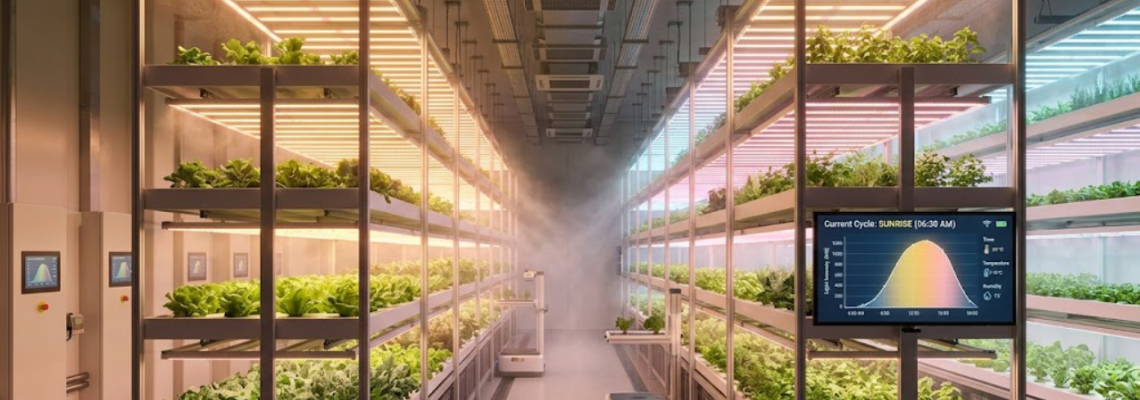
Agriculture is rapidly transforming as global demand for food continues to rise while resources become more limited. Indoor farming and Controlled Environment Agriculture (CEA) are leading this shift, allowing growers to produce crops year-round with greater precision, control, and consistency. In these systems, several factors influence plant growth, but light remains the most essential element.
Today, farming is not just about providing enough light it’s about using light in a smarter, more efficient way. Traditional methods of constant or fixed lighting are being replaced by advanced approaches that better align with natural conditions.
One of the most impactful innovations is the automation of sunrise-to-sunset light cycles indoors. By mimicking the natural progression of daylight, these systems create a more balanced environment for plants. Gradual changes in light intensity help reduce stress, improve photosynthesis, and support healthier growth.
As a result, smart farms can achieve higher yields, improved crop quality, and better energy efficiency. By combining technology with nature-inspired lighting strategies, modern agriculture is becoming more sustainable and better equipped to meet future food demands.
The Importance of Light in Plant Growth
Light is the primary energy source for plants. Through photosynthesis, plants convert light into the energy needed for growth and development. But light also influences several other processes, including:
Germination
Leaf expansion
Flowering and fruiting
Circadian rhythms
In nature, these processes are guided by the sun’s daily cycle. Sunrise gradually increases light intensity, midday provides peak energy, and sunset allows plants to transition into rest.
In indoor environments, however, this natural rhythm must be recreated artificially.
From Static Lighting to Intelligent Automation
Traditional indoor farming systems relied on simple timers to control lighting. Lights would turn on and off at fixed times, often at full intensity. While this method provides basic illumination, it does not reflect the natural conditions plants evolved under.
This approach has several limitations:
Sudden light changes can stress plants
Inefficient energy use
Limited flexibility for different crops
Inconsistent growth patterns
To overcome these challenges, modern farms are adopting automated lighting systems that simulate natural sunrise-to-sunset cycles.
What Is Sunrise-to-Sunset Automation?
Sunrise-to-sunset automation is a smart lighting approach that mimics the natural progression of daylight using advanced LED systems and automation tools.
Instead of abrupt lighting changes, these systems:
Gradually increase light intensity at the start of the day (sunrise)
Maintain optimal brightness during peak growth hours
Gradually decrease intensity at the end of the day (sunset)
Adjust schedules based on plant type and growth stage
This creates a more natural and balanced environment for plants.
The Role of LED Technology
LED (Light Emitting Diode) grow lights are the backbone of automated lighting systems. Unlike traditional lighting technologies, LEDs offer:
Precise control over intensity
Adjustable light spectrum
Instant dimming capabilities
Low heat output
High energy efficiency
These features make it possible to simulate natural daylight conditions with remarkable accuracy.
Benefits of Automating Light Cycles
1. Reduced Plant Stress
Plants are highly sensitive to changes in their environment. Sudden exposure to intense light can disrupt their biological processes.
Gradual transitions in light intensity allow plants to adapt naturally, reducing stress and promoting healthier growth.
2. Improved Photosynthetic Efficiency
When light intensity increases gradually, plants can activate photosynthesis more efficiently. This leads to better energy conversion and improved growth rates.
3. Higher Crop Yields
Optimized light delivery ensures that plants receive the right amount of energy at the right time. This results in increased productivity and higher yields.
4. Consistent Crop Quality
Automated lighting systems provide uniform conditions across all plants, leading to consistent size, color, and quality.
5. Energy Efficiency
Smart lighting systems reduce energy waste by:
Adjusting intensity based on need
Eliminating unnecessary lighting hours
Optimizing light distribution
This helps lower electricity costs without compromising plant growth.
Integration with Smart Farming Technologies
Sunrise-to-sunset automation is often part of a broader smart farming ecosystem that includes:
IoT sensors
Climate control systems
Automated irrigation
Artificial intelligence (AI)
Real-Time Monitoring
Sensors track environmental conditions such as temperature, humidity, and plant health. This data is used to adjust lighting automatically.
AI-Driven Optimization
AI systems analyze data to determine the most effective lighting strategies for different crops and growth stages.
Remote Control
Growers can monitor and control lighting systems through digital platforms, enabling greater flexibility and efficiency.
Applications in Modern Farming Systems
Vertical Farming
In vertical farms, where crops are grown in stacked layers, artificial lighting is essential. Automated systems ensure uniform light distribution across all levels.
Greenhouses
Even in greenhouse environments, automated lighting can supplement natural sunlight, ensuring consistent photoperiods during cloudy days or shorter seasons.
Hydroponics and Aeroponics
These systems rely entirely on controlled environments. Automated lighting enhances their efficiency by aligning light cycles with plant needs.
Balancing Productivity and Sustainability
One of the biggest challenges in indoor farming is balancing productivity with sustainability. Lighting systems consume a significant amount of energy, making efficiency a top priority.
Sunrise-to-sunset automation addresses this challenge by:
Reducing unnecessary energy use
Lowering operational costs
Minimizing environmental impact
This makes indoor farming more sustainable and scalable.
Human-Centric Benefits
Modern indoor farms are also workplaces for people. Automated lighting systems can improve working conditions by:
Providing comfortable light levels
Reducing glare and eye strain
Enhancing visibility for tasks
This creates a better environment for both plants and workers.
Challenges and Considerations
While automated lighting offers many benefits, there are some challenges to consider:
Initial Investment
Advanced LED systems and automation tools require upfront costs.
Technical Expertise
Growers need to understand how to optimize lighting schedules.
System Integration
Implementing these systems may require updates to existing infrastructure.
Despite these challenges, the long-term benefits often outweigh the initial costs.
The Future of Smart Lighting in Agriculture
The future of indoor farming will be shaped by continued innovation in lighting technology.
AI-Powered Systems
Future systems will use AI to automatically adjust lighting based on plant responses.
Dynamic Light Recipes
Customized lighting strategies will be developed for specific crops.
Renewable Energy Integration
Combining LED systems with renewable energy sources will further improve sustainability.
Fully Autonomous Farms
Lighting, irrigation, and climate control will operate seamlessly with minimal human intervention.
Conclusion
Smart farming truly starts with light. By automating sunrise-to-sunset cycles indoors, modern agriculture is bringing nature’s rhythm into controlled environments.
This approach not only improves plant health and productivity but also enhances energy efficiency and sustainability. With the help of LED technology, automation, and data-driven insights, growers can create optimal conditions for crops at every stage of growth.
As indoor farming continues to expand, automated lighting will play a central role in shaping the future of agriculture. The farms that succeed will be those that use light not just as a resource but as a precisely controlled tool for growth and innovation.
5 Comment(s)
Hi, thank you for sharing this insightful article. I found your explanation particularly useful and easy to follow. The points you discussed provide valuable information for readers who are looking to understand this topic better. I also have a website about https://www.microthings.id/ ,just let me know if we have another super usefull article.
References:
With blackjack and hookers board-en.drakensang.com
References:
Ameristar casino st charles maps.google.mg
References:
Harris casino http://forum.vhfdx.ru
References:
Rivers casino pittsburgh pa git.hi6k.com
Leave a Comment