
Introduction
As agriculture embraces innovation to meet the demands of a growing global population, lighting technology has become one of the most influential factors in modern crop production. Indoor farms, greenhouses, vertical farms, and controlled environment agriculture (CEA) facilities increasingly rely on LED grow lights to create ideal growing conditions. While traditional LED systems provide fixed light spectrums, Tunable Spectrum Technology takes plant lighting to the next level by allowing growers to dynamically adjust light wavelengths according to plant needs.
Instead of delivering the same light throughout a plant's lifecycle, tunable spectrum lighting enables growers to modify the ratio of blue, red, green, far-red, and white light at different growth stages. This precision helps maximize photosynthesis, improve crop quality, accelerate growth, increase yields, and reduce unnecessary energy consumption.
In this guide, we'll explore how tunable spectrum technology works, why it's transforming modern agriculture, and how growers can leverage dynamic lighting to produce healthier, higher-quality crops while improving operational efficiency.
What Is Tunable Spectrum Technology?
Tunable Spectrum Technology refers to LED lighting systems capable of adjusting the composition and intensity of different light wavelengths. Unlike conventional grow lights with fixed output, these advanced systems let growers customize the lighting environment to match specific crop requirements.
Plants respond differently to various wavelengths of light. By controlling these wavelengths, growers can influence plant behavior, including:
Seed germination
Root development
Leaf expansion
Stem strength
Flower initiation
Fruit production
Color development
Nutrient concentration
Overall crop quality
Rather than using one lighting recipe for every crop, tunable spectrum LEDs create optimized lighting programs tailored to each species and growth stage.
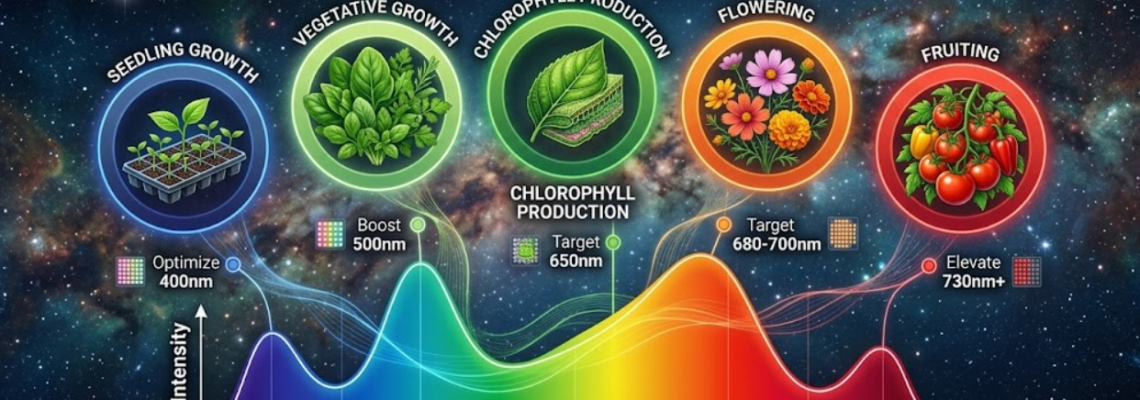
Understanding the Plant Light Spectrum
Plants use light differently than humans perceive it. While humans see brightness and color, plants absorb specific wavelengths for photosynthesis and developmental signals.
Blue Light (400–500 nm)
Blue light promotes:
Strong root systems
Compact plant structure
Leaf development
Chlorophyll production
Higher nutrient density
Ideal for:
Seedlings
Herbs
Leafy greens
Early vegetative growth
Green Light (500–600 nm)
Although once considered less useful, green light:
Penetrates deeper into plant canopies
Supports lower leaf photosynthesis
Improves uniform growth
Enhances canopy light distribution
Red Light (600–700 nm)
Red light is the primary driver of photosynthesis.
Benefits include:
Faster biomass production
Flowering stimulation
Increased fruit yield
Enhanced energy conversion
Ideal during:
Flowering
Fruiting
Mature growth
Far-Red Light (700–750 nm)
Far-red influences plant morphology by:
Encouraging flowering
Increasing leaf expansion
Improving light competition responses
Accelerating flowering cycles
White Light
White LEDs combine multiple wavelengths to provide:
Balanced plant growth
Better crop visibility
Easier inspection
Improved working conditions
Why Plants Need Different Light During Growth
Plants don't require identical lighting from seed to harvest.
Each growth stage demands unique spectral conditions.
Stage 1: Germination
Plants benefit from:
Moderate blue light
Lower intensity
Stable environmental conditions
Result:
Healthy root emergence
Uniform germination
Stage 2: Vegetative Growth
Blue light becomes more important because it:
Builds stronger stems
Produces dense foliage
Encourages compact growth
This stage focuses on maximizing leaf production.
Stage 3: Flowering
Red light dominates.
Benefits include:
Earlier flowering
Better bud development
Increased bloom production
Improved reproductive growth
Stage 4: Fruiting
Dynamic lighting shifts again.
Additional red and far-red wavelengths help:
Increase fruit size
Improve color
Enhance sweetness
Increase yield consistency
How Tunable Spectrum Technology Works
Modern LED grow lights contain multiple independent LED channels.
These channels may include:
Blue LEDs
Deep blue LEDs
Red LEDs
Deep red LEDs
Far-red LEDs
White LEDs
Green LEDs
Smart controllers allow growers to independently adjust each channel.
Instead of manually changing fixtures, software automatically transitions between lighting recipes throughout the crop cycle.
Some systems even integrate with:
Environmental sensors
Climate control systems
CO₂ monitoring
Irrigation controls
AI-powered growth algorithms
This creates a fully automated growing environment.
Key Benefits of Dynamic Spectrum Lighting
1. Faster Plant Growth
Plants receive exactly the wavelengths they need at every stage.
This improves photosynthetic efficiency while reducing growth stress.
Result:
Faster harvest cycles
Increased annual production
2. Improved Crop Quality
Customized lighting improves:
Leaf color
Flavor
Texture
Nutrient density
Essential oil production
Premium-quality crops often command higher market prices.
3. Higher Crop Yields
Optimized light recipes help plants convert energy more efficiently.
Growers frequently experience:
Larger plants
More flowers
Higher fruit counts
Better harvest consistency
4. Better Energy Efficiency
Instead of running every LED channel at maximum power continuously, tunable systems activate only the necessary wavelengths.
Benefits include:
Lower electricity consumption
Reduced operating costs
Longer fixture lifespan
5. Greater Crop Flexibility
One lighting system can grow multiple crops by simply changing the lighting program.
Examples include:
Lettuce
Tomatoes
Strawberries
Basil
Cannabis (where legally permitted)
Cucumbers
Spinach
Microgreens
No hardware replacement is required.
6. Consistent Harvest Quality
Dynamic lighting minimizes variability between production cycles.
Growers achieve:
Uniform crop size
Consistent color
Predictable harvest timing
Improved product quality
Applications Across Modern Agriculture
Vertical Farming
Vertical farms depend entirely on artificial lighting.
Tunable spectrum LEDs allow operators to:
Maximize limited growing space
Increase annual harvests
Produce premium leafy greens year-round
Greenhouses
Natural sunlight constantly changes.
Dynamic LEDs supplement sunlight by:
Filling spectral gaps
Extending daylight hours
Maintaining consistent crop performance
Hydroponics
Hydroponic systems benefit from precise environmental control.
Combined with nutrient management, tunable lighting creates ideal growing conditions.
Plant Research
Universities and research facilities use tunable spectrum technology to study:
Plant genetics
Growth optimization
Stress responses
Nutrient development
Commercial Horticulture
Large-scale growers use dynamic lighting for:
Ornamentals
Herbs
Vegetables
Fruits
Seed production
Integration with Smart Farming
The newest generation of tunable spectrum lighting works alongside smart agriculture technologies.
These include:
IoT sensors
Artificial intelligence
Cloud monitoring
Automated scheduling
Environmental control systems
For example:
If sensors detect cloudy weather, lighting automatically increases.
If flowering begins earlier than expected, the system adjusts the spectrum accordingly.
This level of automation improves both productivity and efficiency.
Sustainability Advantages
Modern agriculture faces increasing pressure to reduce its environmental footprint.
Tunable spectrum technology supports sustainability by:
Lowering electricity usage
Reducing heat generation
Conserving water through healthier plant growth
Decreasing fertilizer waste
Minimizing crop losses
Extending LED fixture lifespan
These benefits contribute to more sustainable food production while lowering operational costs.
Choosing the Right Tunable Spectrum LED System
When selecting a lighting solution, consider the following factors:
Spectrum Control
Choose fixtures that offer independent control of multiple wavelength channels.
Energy Efficiency
Look for high photosynthetic photon efficacy (PPE) ratings to maximize light output while minimizing energy use.
Smart Integration
Ensure compatibility with:
Environmental sensors
Climate control systems
Automation platforms
Remote monitoring software
Crop Compatibility
Verify that the system includes lighting recipes for your intended crops or allows custom spectrum programming.
Scalability
Select a modular system that can expand as your growing operation increases.
Reliability
Prioritize durable fixtures with efficient heat management, long lifespans, and strong manufacturer support.
The Future of Tunable Spectrum Technology
Rapid advances in LED engineering, artificial intelligence, and precision agriculture are shaping the next generation of horticultural lighting.
Future systems are expected to offer:
Real-time spectrum optimization based on plant health
AI-driven lighting recommendations
Automated adjustments using computer vision
Digital twin simulations for crop growth
Integration with robotics and autonomous farming systems
These innovations will help growers achieve even greater efficiency, consistency, and sustainability while reducing labor and resource consumption.
Best Practices for Maximizing Results
To get the most from tunable spectrum technology:
Match light recipes to each crop and growth stage.
Monitor plant responses regularly and adjust settings as needed.
Combine dynamic lighting with proper irrigation, nutrients, and climate control.
Use sensors to automate lighting schedules.
Track energy usage to optimize operating costs.
Keep fixtures clean and well-maintained for consistent performance.
Conclusion
Tunable Spectrum Technology is revolutionizing horticultural lighting by giving growers unprecedented control over the light environment. Rather than relying on a fixed spectrum, dynamic LED systems allow precise adjustments throughout every stage of plant development, resulting in healthier crops, faster growth, improved yields, superior quality, and greater energy efficiency.
Whether used in vertical farms, greenhouses, hydroponic facilities, or research environments, tunable spectrum lighting enables producers to tailor growing conditions for maximum performance while supporting sustainability goals. As AI, IoT, and automation continue to evolve, these intelligent lighting systems will play an even greater role in shaping the future of precision agriculture.
For growers seeking higher productivity, premium crop quality, and long-term operational savings, investing in tunable spectrum technology is a forward-thinking step toward a more efficient and resilient agricultural future.
Leave a Comment